
BESS Safety Matters: Thermal Runaway Risks and Multi-Layer Protection Systems
Global energy storage is accelerating — but is safety keeping pace?
In 2025, global deployed BESS capacity grew by approximately 700GWh. Yet as of May 2025, at least 167 fire or explosion incidents related to energy storage had been reported worldwide. In 2025 alone, the number of energy storage fire incidents globally approached 20. This is not alarmism — this is a reality we must face.
What Is Thermal Runaway?
The primary safety concern for Li-ion batteries is thermal runaway — a phenomenon wherein an accelerating release of heat inside a cell, due to a series of exothermic reactions, manifests as an exponential, uncontrollable increase in cell temperature. When a damaged or malfunctioning lithium battery undergoes a chemical reaction that results in uncontrollable exothermic heat generation, this chain reaction is triggered.
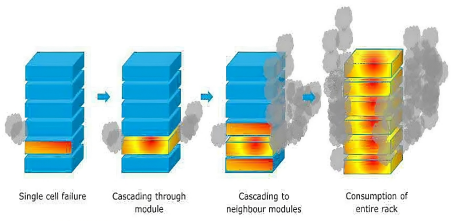
Even more dangerous is “propagating” or “cascading” thermal runaway — when the heat from one battery causes adjacent batteries within the BESS to also experience thermal runaway, spreading like dominoes. This is where the real danger lies.
Key triggers of thermal runaway include:
- Overcharging or overdischarging——Pushing the battery to its limit causes overheating.
- Physical damage or manufacturing defects——Cracks, perforations, or design defects.
- Environmental conditions——High temperature or external heat source.
Real-World Warnings
These are not theoretical risks. In just the past two years:
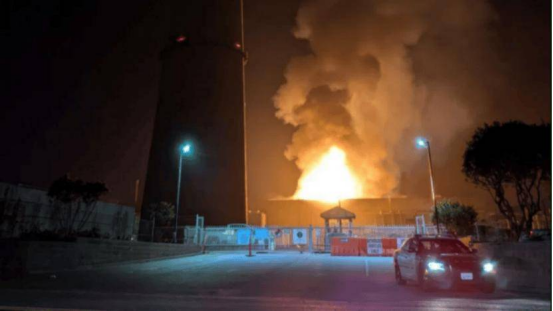
Moss Landing, California, USA (January 2025): A fire broke out at one of the world’s largest battery energy storage facilities, forcing the evacuation of over 1,000 residents. Firefighters implemented a “monitoring and containment” strategy to allow the fire to extinguish naturally.
Neermoor, Germany (April 2024): Multiple lithium-ion containers caught fire; an explosion occurred when firefighters opened them, injuring two personnel and causing a six-hour closure of the nearby highway. Kagoshima, Japan (March 2024): A fire broke out at the BESS battery storage facility; an explosion occurred during firefighters’ attempt to activate the smoke exhaust system, leaving four firefighters injured.
California Gateway Energy Storage Facility (May 2024): A fire at the 250 MW facility remained active and reignited multiple times.
Multi-Layer Protection: The Swiss Cheese Model of Safety
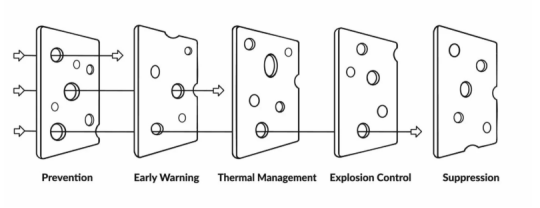
In response to these risks, the industry has developed a multi-layer protection system. As illustrated by the Swiss Cheese Model of Safety — each layer may have holes, but multiple layers together maximize the chance of stopping a disaster.
Layer 1: Prevention
Prevention starts with continuous monitoring of conditions that may cause a short circuit — humidity, temperature, dust, corrosion, and more. Temperature control is essential for preventing thermal runaway, with liquid cooling circulating coolant around battery packs to maintain optimal temperatures.
Layer 2: Early Warning
The BMS (Battery Management System) must be combined with additional detection for redundancy. This includes:
Fibre Optic Linear Heat Detection
Smoke detectors (preferably aspiration type)
Hydrogen detectors — the best early indicator of thermal runaway
Layer 3: Thermal Propagation Management
The only proven method of suppressing BESS fires and cascading thermal runaway is ‘thermal propagation management’ . This includes:
Passive fire-resistant materials: Mica and ceramic materials play a critical role in preventing the spread of thermal runaway.
Active fire suppression systems: Fire extinguishing systems such as cleaning agents, fine water mist, and aerosols.
Emergency ventilation and explosion prevention controls: Preventing the accumulation of flammable gases.
International Safety Standards Are Evolving
Global safety standards are rapidly catching up. Here’s what every energy storage professional should know:
Standard | Key Update |
NFPA 855 (2026 edition) |
UL 9540A testing and large-scale fire testing are required; Hazard Mitigation Analysis (HMA) has become a mandatory requirement; it is explicitly stipulated that the concentration of flammable gases must not exceed the Lower Explosive Limit (LFL). |
UL 9540A (6th edition) |
For the first time, large-scale fire testing has been incorporated into the standard specification. |
ISO 3941:2026 |
Officially established the “Category L Fire” classification – specifically designed for lithium-ion battery fires. |
Industry Progress
The good news: the industry is learning. According to EPRI (Electric Power Research Institute), the BESS failure rate dropped by 98% from 2018 to 2024 — lessons learned from early failures have been incorporated into the latest designs and best practices. In 2023, only 15 grid-scale BESS failures were reported globally, and 2024 saw only five. The number of fires has held constant or dropped while global grid-scale battery energy storage capacity has grown dramatically.
As Robin Zeng, Chairman and CEO of CATL, said: “Safety is the foundation of energy storage development. Any safety incident can undermine public trust.”
Conclusion
Energy storage is the cornerstone of the energy transition, but safety must be the top priority. The risk of thermal runaway is real, but through multi-layer protection systems — from prevention and early warning to thermal propagation management and international standards compliance — we can minimize the risk.
Safety is not a cost — it‘s an investment. Every incident reminds us: in the pursuit of greater capacity and higher efficiency, we must never forget that safety is the lifeline.
What questions do you have about C&I energy storage? Drop them in the comments below!